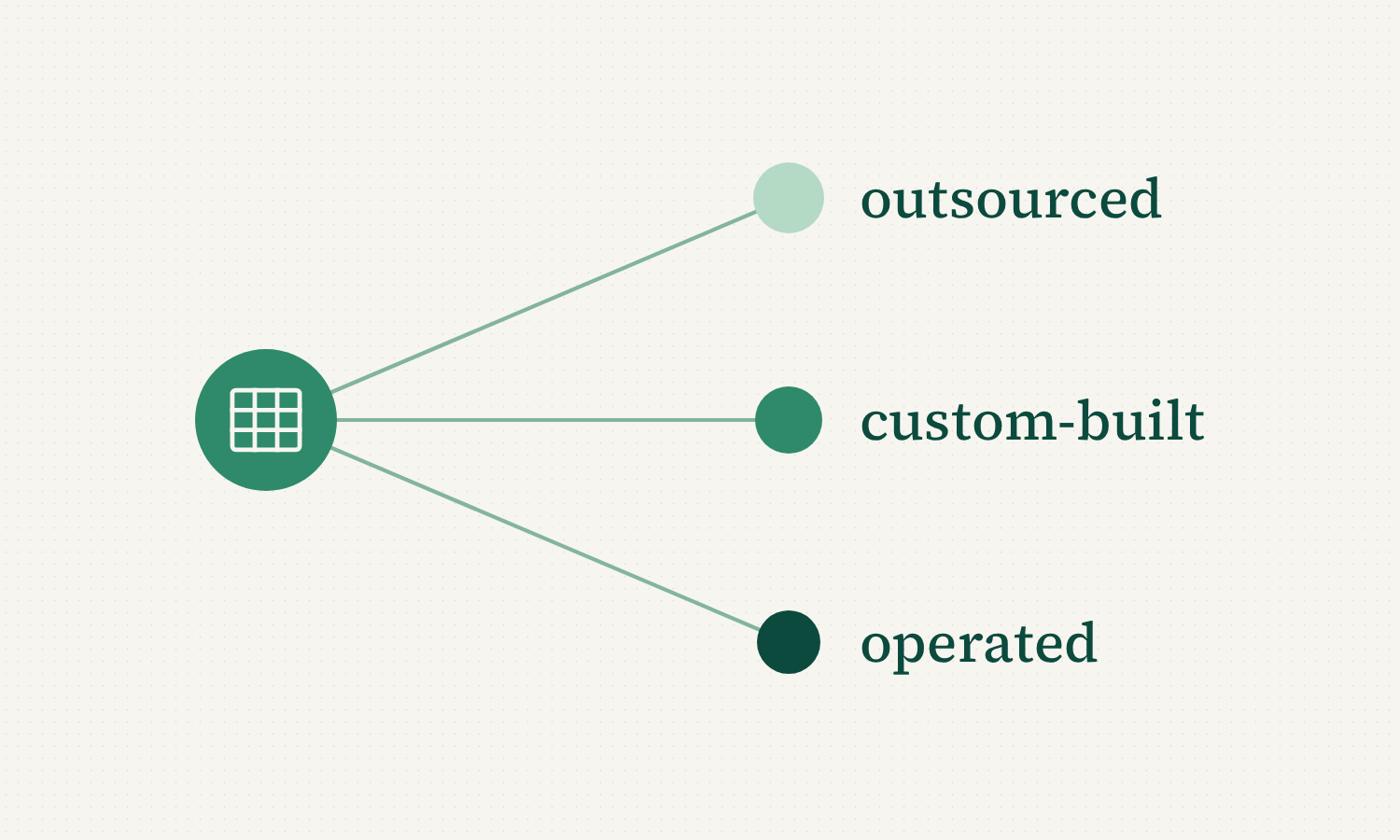
When a utility decides it is time to move off spreadsheets, there are more paths forward than “buy software.” We see three distinct approaches utilities take, and each one comes with a real tradeoff worth understanding before you commit to one.
Path one: outsource the whole program
Some vendors offer a fully managed model. Their staff runs your surveys, sends your notices, and compiles your reports. Your team steps back from the day-to-day work entirely.
This is a legitimate choice for a utility with genuinely thin staff and no capacity to run a program directly. It is not a bad decision by definition. But it comes with a real cost that goes beyond the invoice.
When another company runs your compliance program, your customer relationships run through them too. Notices go out under their process, on their timeline, using their language. If you ever want a full, detailed history of what happened with a specific account, you are asking a vendor for it, not pulling it up yourself. If you ever want to switch providers, you are negotiating the return of data and process knowledge that has lived outside your organization the whole time.
None of this makes full outsourcing the wrong choice for every utility. It means the tradeoff is control, not just cost, and that tradeoff deserves to be named directly rather than discovered later.
A useful test: if you asked to see every interaction with a specific customer over the last three years, right now, would you get that directly from your own system, or would you need to ask an outside company for it? Neither answer is automatically wrong. But only one of them means the answer is fully in your hands.
Path two: build something custom
We are seeing a second pattern more lately. Custom compliance tracking tools are being built on top of general-purpose Microsoft platforms, things like Power Platform or SharePoint, configured specifically for one utility’s program.
This can look appealing at first. It is tailored exactly to how your team already works, and it often comes from someone who took the time to understand your process closely.
The tradeoff shows up later. A custom build on a general-purpose platform is not really software, in the sense of a maintained, purpose-built product. It is a configuration, usually understood in full by one consultant or one internal champion. When that person moves on, the institutional knowledge of how the system actually works often goes with them. Updates, fixes, and regulatory changes depend on that same person’s availability, not a dedicated product team’s roadmap.
We have also seen this approach carry a real, ongoing cost that is easy to underestimate at the outset. Custom consulting engagements do not end at go-live. In the arrangements we have seen, every workflow change, every new regulatory requirement, and every bug fix is a new billable request rather than an included update. What looks like a lower upfront cost compared to a subscription can turn into a larger total spend once you account for years of ongoing consulting work.
There is also a reliability question worth asking directly. General-purpose platforms like Power Platform or SharePoint were not built with water compliance logic in mind. Features that a purpose-built compliance tool would treat as core, validation rules for test results, automated notice timing tied to regulatory deadlines, audit-ready reporting, often have to be recreated from scratch inside a tool that was never designed for them. That gap does not always show up in a demo. It tends to show up later, during an audit or a staffing transition, when the person who understands the custom configuration is not available.
Path three: purpose-built software you operate yourself
The third path is a platform built specifically for water compliance work, backflow, FOG, stormwater, or pretreatment, that your own team operates directly.
This is the path we build for, and we think it is worth being direct about the actual case for it rather than a generic pitch. It keeps your customer relationships and your program’s history inside your own organization, not with an outside operator. It comes from a dedicated product team with a real roadmap, not a single consultant’s availability. It is built specifically for water compliance logic from the ground up, not a general-purpose platform bent into that shape.
It is also not free of tradeoffs. Your team runs the day-to-day work themselves, which means the staff-time savings depend on the tool actually reducing that workload, not just moving it from paper to a screen. That is a fair thing to hold any purpose-built platform accountable for, including ours.
It is worth being specific about what “purpose-built” actually means in practice, since the term gets used loosely. It means validation logic already built for backflow test results and FOG inspection cycles, not recreated from a blank canvas. It means notice timing already tied to the regulatory deadlines your program has to meet. It means an update to handle a new state reporting requirement ships to every customer on the platform at once, not as a billable change order to one custom configuration.
A framework for weighing the three paths
Three questions tend to clarify which path actually fits your situation.
- Who owns the institutional knowledge of how your program runs? If the honest answer is “one outside person or company,” that is a real dependency worth naming, whichever path you are on.
- What happens to your customer relationship data if the arrangement ends? A managed-service provider and a custom-build consultant both raise this question. A platform you operate yourself does not.
- Is the ongoing cost fixed, or does it grow with every change you need? A subscription and a consulting engagement can look similar in year one and very different by year three.
There is no universally correct answer among the three paths. The right one depends on your staff capacity, how much you value keeping your own program history in-house, and how comfortable you are with your compliance workflow depending on one outside person’s availability.
Where to start
If you are weighing these options, we would rather help you think through the real tradeoffs than just make the case for our own path. If you want to talk through what any of this looks like for your specific program, we are glad to walk through it directly.
SwiftComply is purpose-built water compliance software for backflow, FOG, stormwater, and pretreatment programs, operated directly by your own team rather than an outside vendor or consultant. Trusted by more than 700 customers protecting over 50 million citizens across North America. If you are weighing how to run your compliance program, we would like to help you think it through.