Most compliance programs do great work that leadership never sees. That invisibility has a real cost when budget season rolls around. With populations growing and resources tightening, the case you make to senior leaders decides what your program can do next year.
That’s why at our latest quarterly customer summit, we got compliance managers and senior leaders in the same room to hear from both sides.
Key takeaways
- The problem is turning technical compliance work into terms leadership understands.
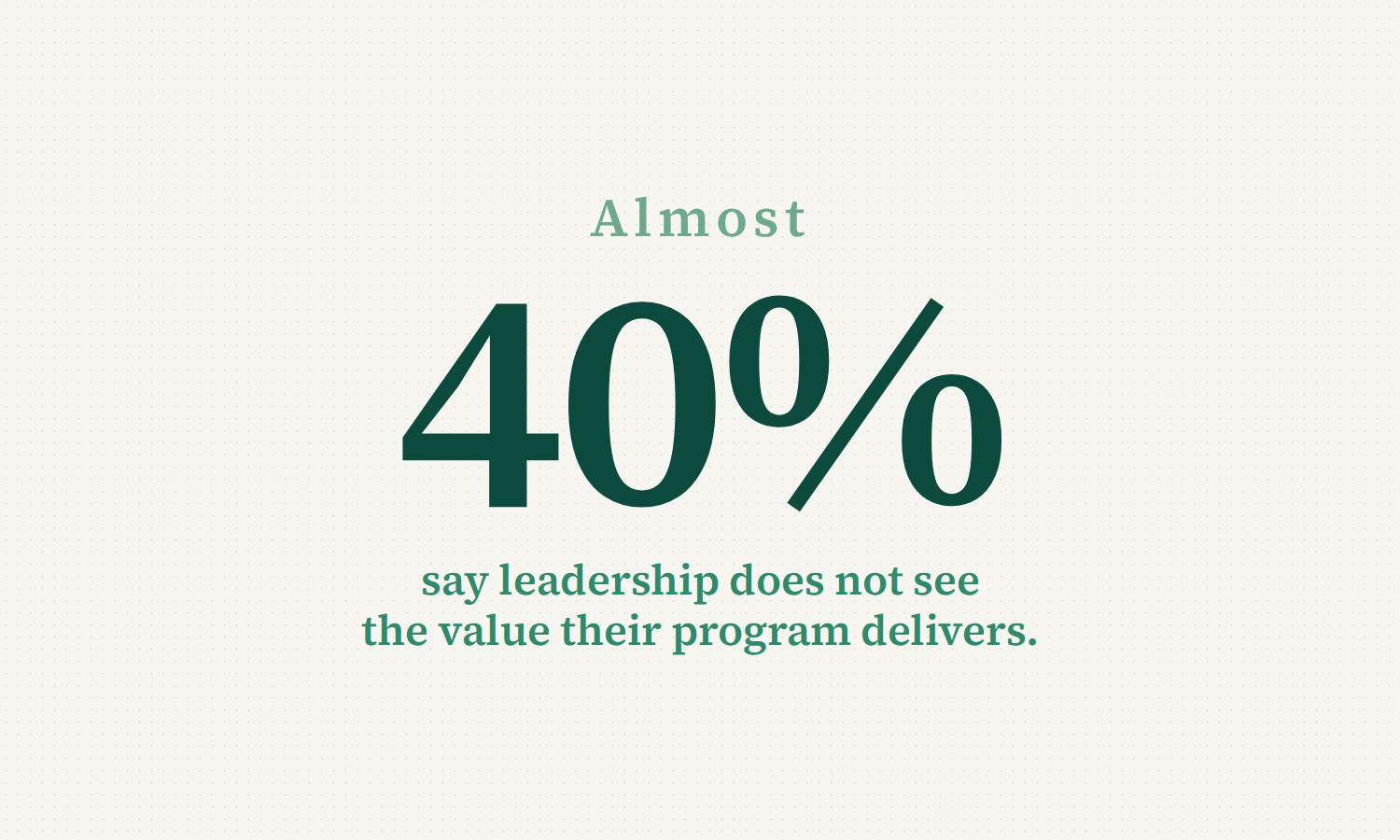
- Almost 40% of the program managers we surveyed said leadership does not see the value their program delivers.
- Councils respond to outcomes, not technical detail. You need to frame the work around what your audience already cares about.
- The data matters, but what moves a program forward is the relationship with the people you report to.
Compliance only gets noticed when something breaks
No news is good news. It is the line compliance pros reach for, and it sums up the bind you are often in.
When the water is safe and the lights are on, nobody upstream thinks about the program keeping it that way. When something breaks, everybody is. That is a hard place to work from.
Our founder Mick, a former wastewater engineer, put a question to the room. If your city manager sat you down tomorrow and asked what you do and why it matters, could you answer in 60 seconds without opening a spreadsheet? Many cannot.
His point was not that compliance teams communicate badly. “It’s not a communication problem,” he said. “It’s a translation problem.”
That single idea ran through the whole event. The work goes unrecognized because no one has translated it into language leadership understands.
Leadership often can’t see the value you deliver
Ahead of the event, we surveyed compliance managers on how well the decision-makers in their organization understand their work.
- Almost 40% said leadership does not see the value their program delivers.
- More than half said their program does not get the credit it has earned.
- 56% said their reports could do more to show the program’s value.
- Two thirds do not clearly connect their program’s goals to their city’s strategic plan.
- Nearly a third have taken a direct budget hit in the past two years.
The data exists and the effort is real. It just rarely reaches leadership in a form they can read. By the time a monthly report lands on a manager’s desk, it can flatten into a wall of numbers.
And yet water runs under almost every objective in a city’s plan, but the work rarely gets connected to it. And the money is only getting tighter: the national water funding gap is projected to reach $194 billion by 2030.
Visibility is how a program protects what it has – and the programs that cannot show their value are the ones most exposed.
Don’t just report the problem, show it
Our first panel brought together three customers who, as it turned out, had a lot in common. Each runs their backflow program as a team of one:
- Erin Sweeney, cross-connection control for Castle Rock, Colorado.
- Iliya Andreev, more than 22,000 connections for the City of Redmond, Washington.
- Doreen Flansburg, cross-connection and conservation for Cottonwood, Arizona.
When one of them gets leadership to take notice, it is almost never a better report. It is something they can see for themselves: a photo, an example they can picture, a straight conversation. It showed up twice on the panel:
Iliya led with photos. He found a commercial site that had changed an air gap without pulling permits. Rather than open with a violation, he walked his managers through the pictures. “Pictures tell a thousand words,” he said. “Show them what was wrong and what used to be there.” It worked – Leadership got behind him, and the site came back into compliance.
To explain backflow to the public, Doreen reaches for something everyone knows: a house fire. When a fire engine pulls water from the hydrants, the pressure drops — and you don’t want to know what gets sucked back into the water supply.
So before your next leadership update, ask what you could show them instead of writing it up. A photo, a before-and-after, the one number that makes the point on its own. Put that first, and let the detail follow.
Decision-makers care about outcomes
In our second panel, we spoke to three senior leaders who helped decide what to get funded.
- Aimee Kaslik, chief strategy officer in Denton, Texas, and a former water utility business manager.
- Ria Pavia, a deputy director for the City of Ontario, California.
- Chris Fabian, who founded ResourceX (now part of Tyler Technologies) and has spent his career on how cities decide what to fund.
They confirmed the gap is real, and were specific about why it happens and how to close it:
It all comes down to visibility – As Aimee put it, it’s “not a lack of commitment from leadership,” it “goes back to that lack of visibility.” Ria explained that it is the visible projects get the funding, calling it “almost like a popularity contest.” A program that can’t explain itself in plain terms loses ground to one that can.
The key is to focus on outcomes – Reviewing agenda reports is core to Ria’s job, and she’s constantly sending them back to the engineers who wrote them, because the acronyms and regulatory language lose the reader. Chris called it a Rosetta Stone, the move from the language of engineers to the outcomes a community cares about. “It doesn’t take away the importance of the technical aspect,” he said, “but the final step is to convey the technical need in the language of policymakers and priorities.”
Make it something they can see –“What is visible is what gets noticed,” Aimee said. A photograph of a problem on the ground lands in a budget meeting in a way a row of numbers does not, showing leadership something they never see day to day.
How to make your case
- Answer the four questions residents and councils actually ask. Ria’s shortlist:
- Is the water safe?
- Is the infrastructure being maintained?
- Are we being responsible with taxpayer dollars?
- Is the city planning for the future?
- If your work does not visibly connect to one of those, it goes unnoticed because it is assumed.
- Frame around outcomes, then prove efficiency. Chris’s advice: tie the program to strategic priorities like a safer community or economic growth, then show you deliver it efficiently against peer benchmarks. Close with what the work prevents, stated plainly and without theatrics.
- Show, don’t summarize. Aimee and Iliya have very different jobs, but they gave the same advice: lead with what leadership can see, not what they have to read.
- Be transparent about the good and the bad. “We can’t just communicate where it highlights our successes,” Aimee said. Naming the challenges builds the trust that makes the next request easier.
Most importantly invest in the relationship first. This was Iliya’s closing advice. “Data is data. It’s always going to be there. But when they know the name and the face, it instantly pops up. Oh, he wants something. And they’ll react.”