Key takeaways
- Many MS4 programs lose roughly half their inspection capacity to documentation: re-entering the same site visit into a form, a spreadsheet, and a shared drive.
- In SwiftComply’s 2025 survey, compliance professionals ranked data gathering as the most time-consuming part of regulatory reporting. Analysis came last.
- 75% of surveyed compliance professionals at least sometimes encounter missing, incomplete, or inaccurate data.
- Citywide permitting platforms store inspections. Most can’t issue formal notices, attach photos to findings, or follow a BMP through an ownership change. So programs keep a spreadsheet alongside.
- When staff capacity tightens, fieldwork continues but tracking slips first. The gaps don’t show until the annual report.
Where the inspection day actually goes
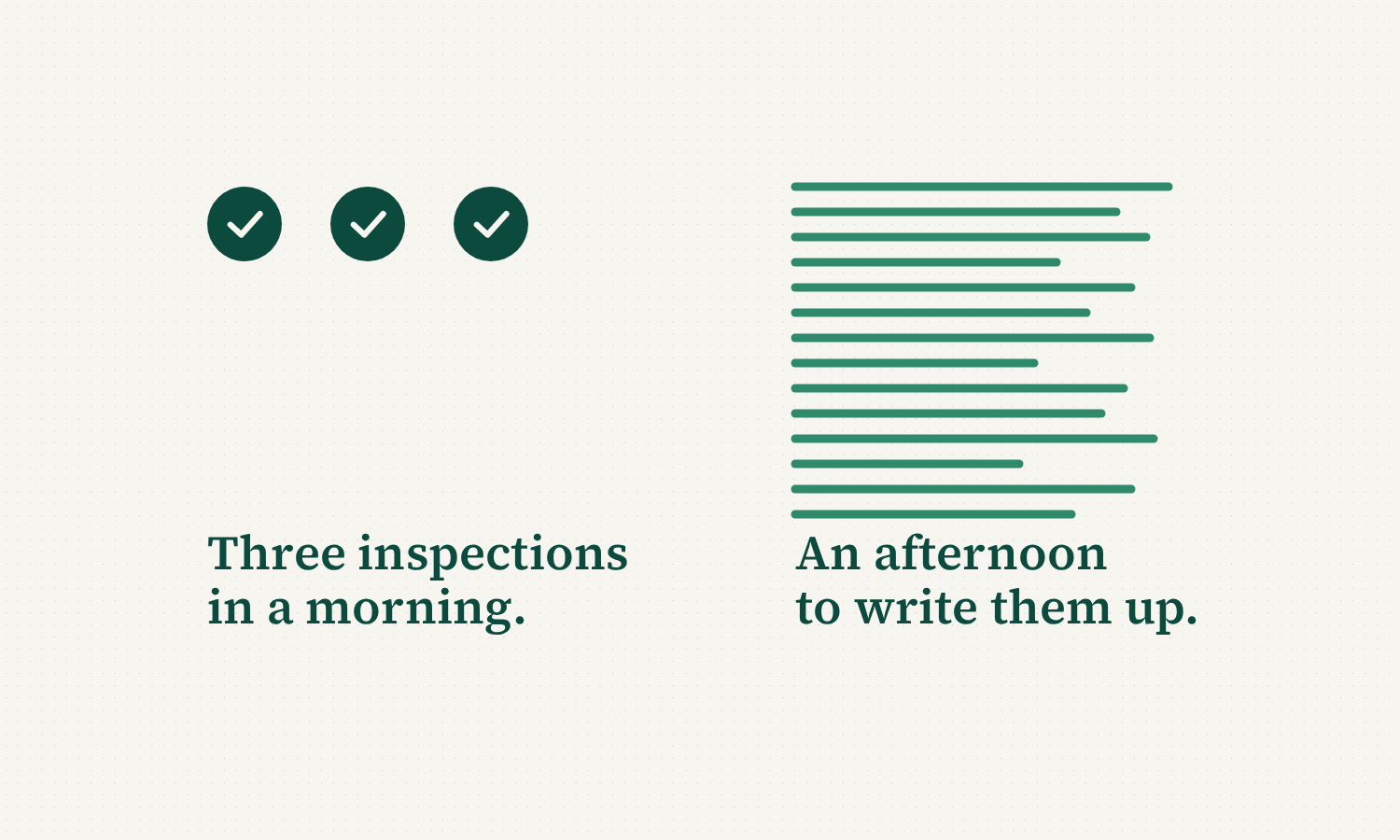
Three inspections in a morning. An afternoon to write them up.
That’s a normal day for a lot of MS4 programs, and it means roughly half your inspection capacity goes to something other than inspecting. Not because anyone is slow — the fieldwork is experienced and well understood. It’s the hours afterward, turning a phone full of photos into something a regulator would accept.
You know the drill:
- Photos come off the phone at the end of the day.
- The inspection form gets filled in back at the desk.
- The same details go into a tracking spreadsheet, then a shared drive.
Twelve months later the annual report needs a count, so someone opens the spreadsheet and works it out all over again.
One filing, six kinds of evidence
An MS4 annual report asks one filing to carry six minimum control measures’ worth of evidence. Almost none of it arrives in the same format, from the same place, or on the same schedule. It’s a concentrated dose of a data problem the whole compliance sector shares.
Over the last few years we’ve surveyed compliance professionals across backflow, pretreatment, FOG and stormwater. The same finding keeps coming back regardless of the program. In our 2025 survey, six in ten describe the way they collect and manage compliance data as basic or moderate.
When we asked which part of regulatory reporting takes the most time, gathering the data came out on top, just ahead of report preparation. Analysis came last. One respondent put it more plainly:
“We’re drowning in data entry and we don’t have time to actually look at what it’s telling us.”
Multiple systems, and none built for MS4 compliance
The typical MS4 program runs on five or six tools, each good at its own job. The trouble is what happens between them: a field form captures a record, but nothing tracks the case, chases the responsible party, or rolls a year of findings into a submission.
List what your own program actually runs on. It is rarely one thing. Word for the inspection forms. Excel for tracking. Survey123 or Field Maps in the field. A shared drive for the finished PDFs, a phone camera roll in between. And increasingly, a sixth: one corner of a citywide platform the city bought for building permits and asked stormwater to fit inside.
GIS especially earns its keep: the asset layer is often the most reliable record a program owns.
The complaint about citywide platforms is always the same. The platform can store a stormwater inspection. It usually cannot issue a formal notice, keep photos attached to the finding they document, or track a BMP through a change of property owner.
The notice is the one that bites. An inspection with no defensible record of notification is hard to enforce and hard to report. So you keep a spreadsheet alongside the platform, and now there are two records of everything.
75% of the respondents we surveyed in 2025 at least sometimes encounter missing, incomplete or inaccurate data.
Under pressure, the tracking slips before the fieldwork does
When capacity gets tight, the inspections do not stop.
What slips is everything downstream of the site visit: the notice that goes out three weeks late, the reinspection nobody scheduled, the BMP certification that came back but never got logged.
A new permit cycle often means something new to track, and the staff to support it rarely arrives alongside. In the same 2025 survey, “limited staff time or competing priorities” was the most-selected barrier to improving how data gets managed. More than half of respondents named it.
It is a credit to the people running these programs that any of this works. It is also a risk. A retirement wave is moving through the water workforce. In many programs the systems hold together because one person knows which spreadsheet is current, which folder has the photos, and why the 2019 count looks wrong.
We have about 8 employees with 30 years all leaving any minute
When that knowledge walks out, what is left is a permit, a program, and a set of records that cannot explain themselves. Running a program from its files alone is a different job from maintaining one you built yourself.
The gaps do not show until the report does
The annual report is where everything a program runs on has to speak with one voice. Anything that never got written down surfaces there. So does anything that never lined up in the first place: GIS exports that disagree with inspection logs, outreach counts that do not match sign-in sheets, a notice that exists only as an email thread.
And your report asks for more than a count: inspections by facility type, deficiencies found, resolutions inside the window. A spreadsheet built to log inspections can rarely produce that without someone rebuilding it by hand.
Asked what still gets in the way, it’s no surprise one stormwater compliance supervisor told us: “Compiling all the different metrics required for monthly and yearly reports.” The number of sites scales with the city. The number of people assembling the report does not.
If someone asked tomorrow where every number in last year’s report came from, how long would it take you to show them?
What changes when the record is captured once
The record still has to be captured. You just do not have to keep re-assembling it.
Two of the stormwater teams we work with are in Kyle and Waco, Texas. They started from different places, but both stories will be familiar.
Kyle ran its program for years on paper checklists and Word templates while the city’s population more than doubled. Inspections were getting done — but as Kyle’s program manager Kathy puts it, “if it’s not documented, you didn’t do it.” With purpose built software, the team is doubling the number of inspections it completes. And the inspection is finished when the site visit is finished rather than reopened that afternoon.
Waco started from the harder place. A citywide restructure cut the stormwater team from eight to three, and the analyst who stepped up rebuilt records scattered across the city into one coherent program.
What changed for both is that the record is captured once, at the point of work, and is still there when needed without anyone reassembling it.
That can be the difference between a program that is compliant and a program that can show it.
If any of this sounds familiar
Most of the stormwater teams we work with started this conversation in the middle of a permit cycle, with more to track than time to track it.
If you want to see how other MS4 programs are handling the reporting load, we would be glad to show you. No pressure. Just a conversation about what you are trying to solve and whether we are a good fit.