If you work in utility operations, “wastewater compliance” probably isn’t one thing to you — it’s a dozen overlapping obligations that all happen to fall under the same umbrella term. That’s part of what makes it hard to manage well: the regulatory landscape is broad, the reporting requirements are scattered across programs, and the consequences of falling behind range from fines to consent decrees.
This is a plain-language overview of what wastewater compliance actually includes, where the pressure is coming from, and what tends to trip utilities up.
What “wastewater compliance” actually means
At its core, wastewater compliance is the set of legal and regulatory obligations a utility takes on when it collects, treats, or discharges wastewater. In the U.S., most of it traces back to the Clean Water Act (CWA), which set the framework for regulating pollutant discharges into the nation’s waters.
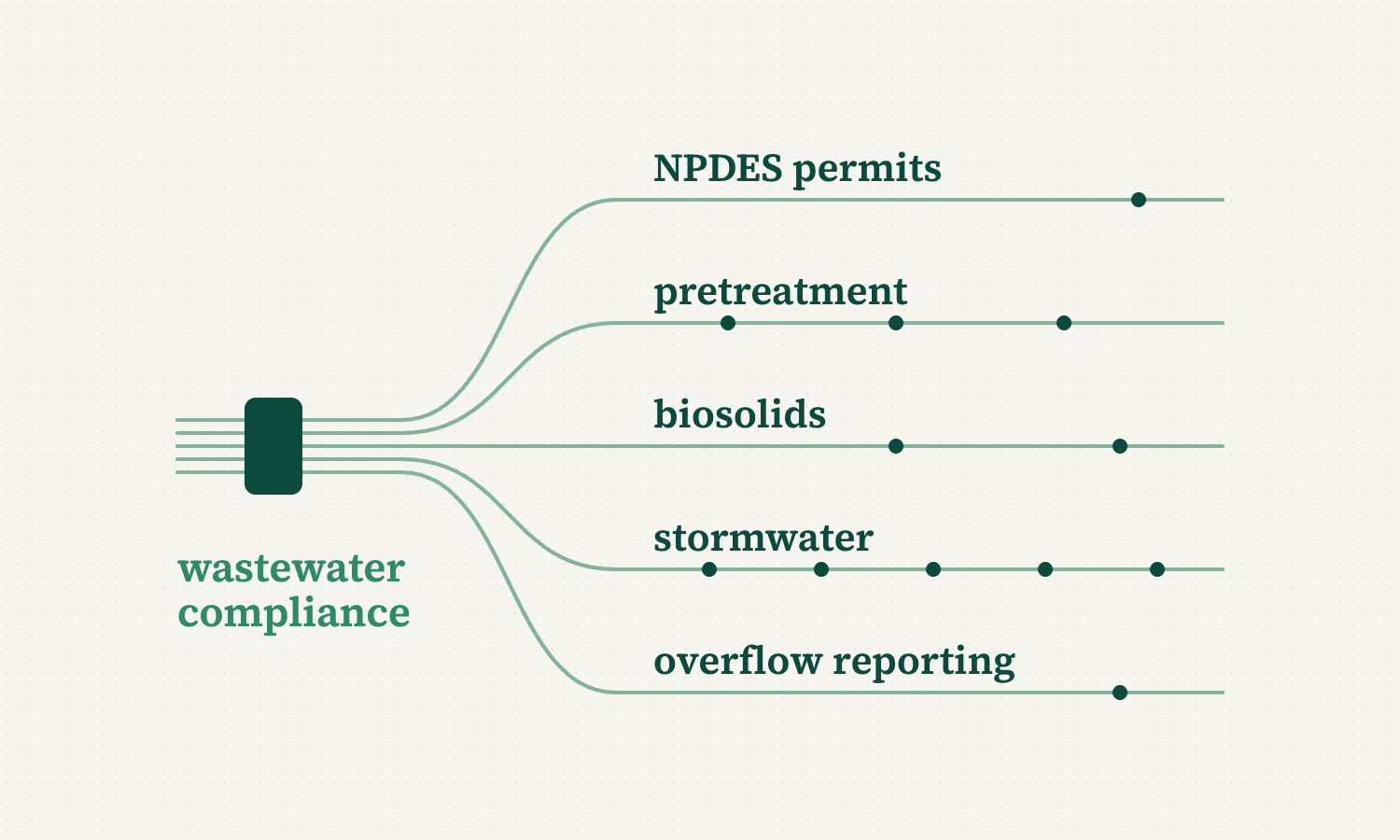
From there, compliance branches into several distinct programs that a utility might be managing at the same time:
- NPDES permits (National Pollutant Discharge Elimination System) — the permits that set discharge limits for treated wastewater leaving a facility.
- Industrial pretreatment programs — rules governing what commercial and industrial users are allowed to send into the sewer system before it reaches the treatment plant.
- Biosolids management — requirements around how treated sludge is handled, stored, and disposed of or reused.
- Stormwater discharge permits — a related but distinct set of obligations (often under an MS4 permit) covering runoff rather than treated effluent.
- Sanitary sewer overflow (SSO) reporting — obligations to report and remediate overflows from the collection system.
Each of these has its own permit cycle, reporting cadence, and documentation requirements — which is why “wastewater compliance” can mean very different day-to-day work depending on which part of the system a given role touches.
Why it’s getting harder, not easier
A few converging trends are making this landscape more demanding, not less:
Aging infrastructure. Much of the country’s collection and treatment infrastructure was built decades ago. As it ages, the risk of overflows, permit violations, and unplanned maintenance climbs — all of which generate compliance obligations of their own.
Tightening standards. Regulatory limits on nutrients, PFAS, and other emerging contaminants continue to evolve, often faster than utilities can fund the capital projects needed to meet them.
Staffing pressure. Compliance work is detail-heavy and relies on institutional knowledge — inspection history, permit nuances, which industrial users have been problematic in the past. Retirements and staffing shortages make that knowledge harder to retain.
Public and legal scrutiny. Compliance records increasingly end up in public records requests, litigation, or media coverage, which raises the cost of incomplete or disorganized documentation.
Where utilities typically get stuck
In practice, the compliance failures that create real problems are rarely about not knowing the rules. They’re about the operational side of tracking them:
- Permit renewal dates, inspection schedules, and reporting deadlines tracked across spreadsheets, shared drives, or a mix of both.
- Inspection and sampling data that lives in the field (on paper, or in a separate system) and has to be manually re-entered before it’s usable for reporting.
- No single, current view of which permits, industrial users, or assets are approaching a compliance deadline.
- Turnover that leaves gaps in institutional knowledge about who’s overdue for what.
None of these are regulatory problems — they’re process and visibility problems. And they tend to compound: a missed inspection becomes a missed report, which becomes a harder conversation with a regulator.
What helps
The utilities that manage this well generally aren’t doing anything exotic — they’re just making the tracking and reporting side of compliance less manual. That usually means:
- Centralizing permit, inspection, and reporting data in one place instead of across disconnected spreadsheets and file shares.
- Automating reminders for renewal dates, inspection cycles, and reporting deadlines so nothing depends on one person remembering.
- Making field data (inspections, sampling results) flow directly into the system of record, rather than requiring manual re-entry.
- Keeping a clear audit trail that holds up if a permit renewal, public records request, or compliance review comes up.
If part of what you’re managing includes stormwater discharge specifically, a stormwater management platform built around inspection tracking and reporting can take a meaningful chunk of that manual work off your team’s plate — worth a look if that’s one of the pieces you’re juggling.
The bottom line
Wastewater compliance isn’t one program — it’s a portfolio of overlapping obligations, each with its own deadlines and documentation requirements. The utilities that handle it well aren’t the ones with fewer rules to follow; they’re the ones who’ve made tracking those rules less dependent on manual effort and institutional memory. Getting that infrastructure right is what turns compliance from a recurring fire drill into routine, manageable work.